Guide scope
Experimental planning guide
What do you want to hold constant?
Start with the cell type and the behaviour you want to measure. Decide whether substrate mechanics is a variable to test or a condition to keep consistent.
What touches the cells?
Specify the protein or matrix coating alongside the mechanical setting. SENCE™ provides an engineered hydrogel surface; your experiment determines the coating, cells and medium.
How will you compare the result?
Bring your existing controls, readout and handling process into the evaluation. The aim is to establish what works in your assay, rather than assume a material change will improve every endpoint.
What is hydrogel cell culture?
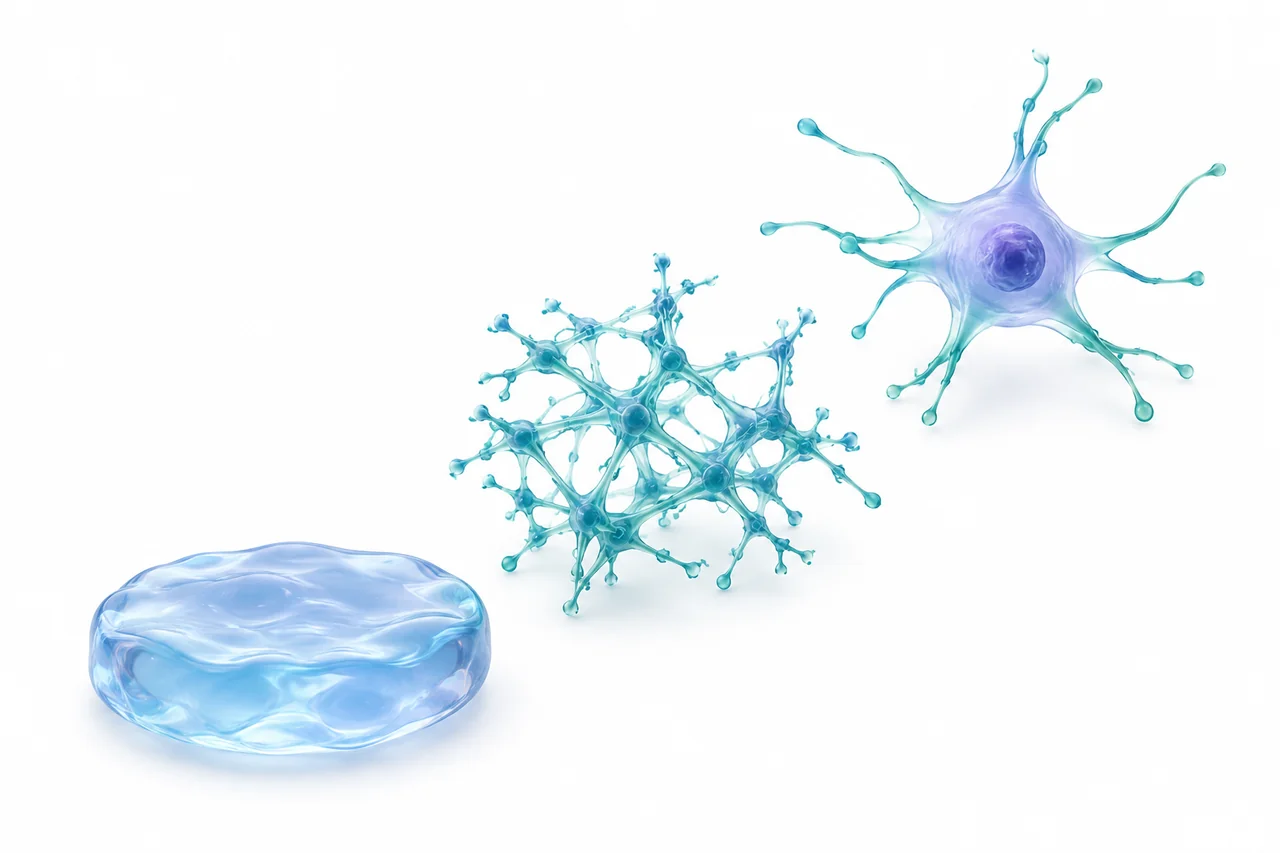
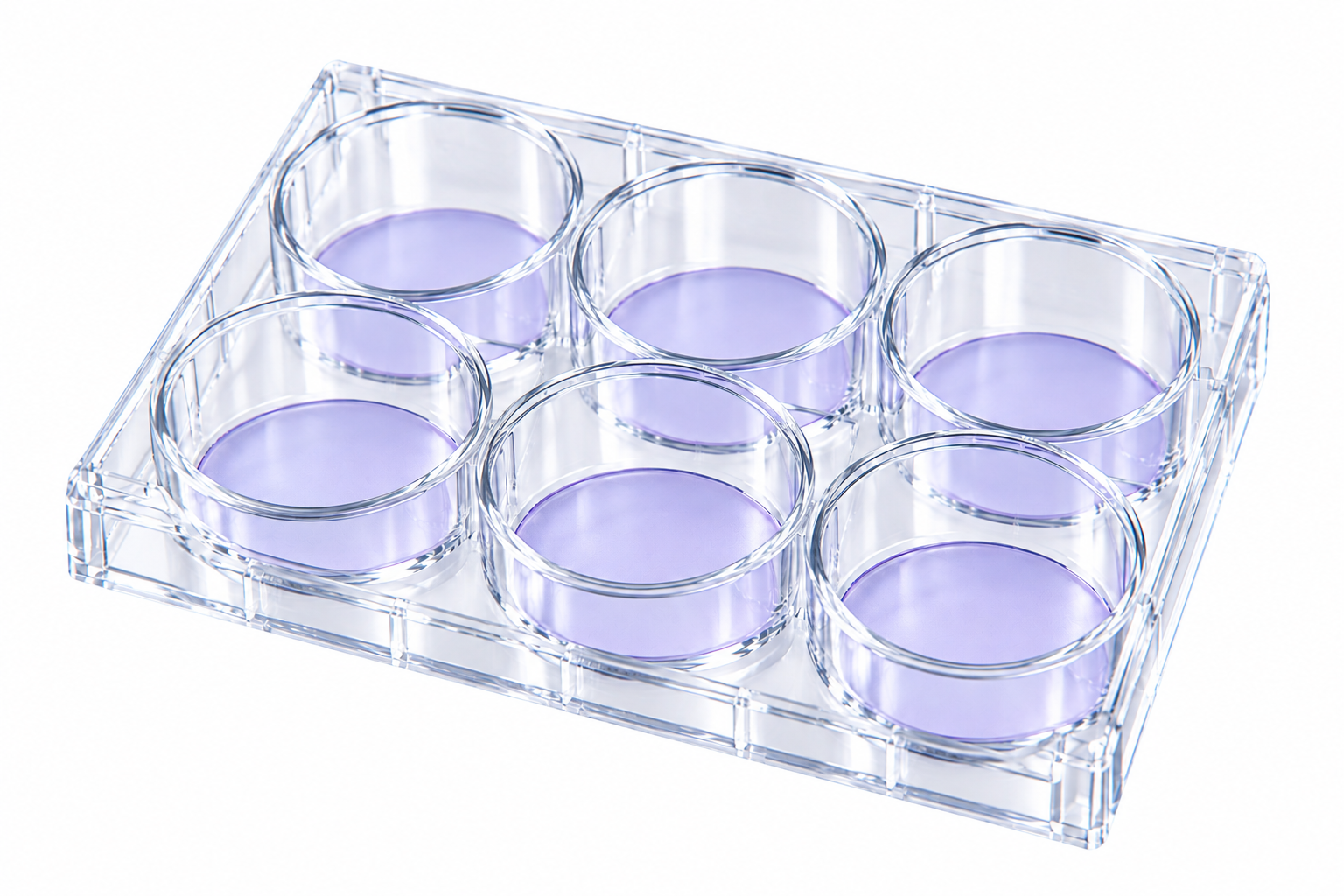
A hydrogel is a water-rich polymer network. Hydrogel cell culture can mean growing cells on its surface or embedding them within a three-dimensional gel. SENCE™ supplies hydrogel-coated plates and coverslips for surface culture: the hydrogel and protein-binding chemistry are already in place, and you add your chosen ECM coating, cells and medium.
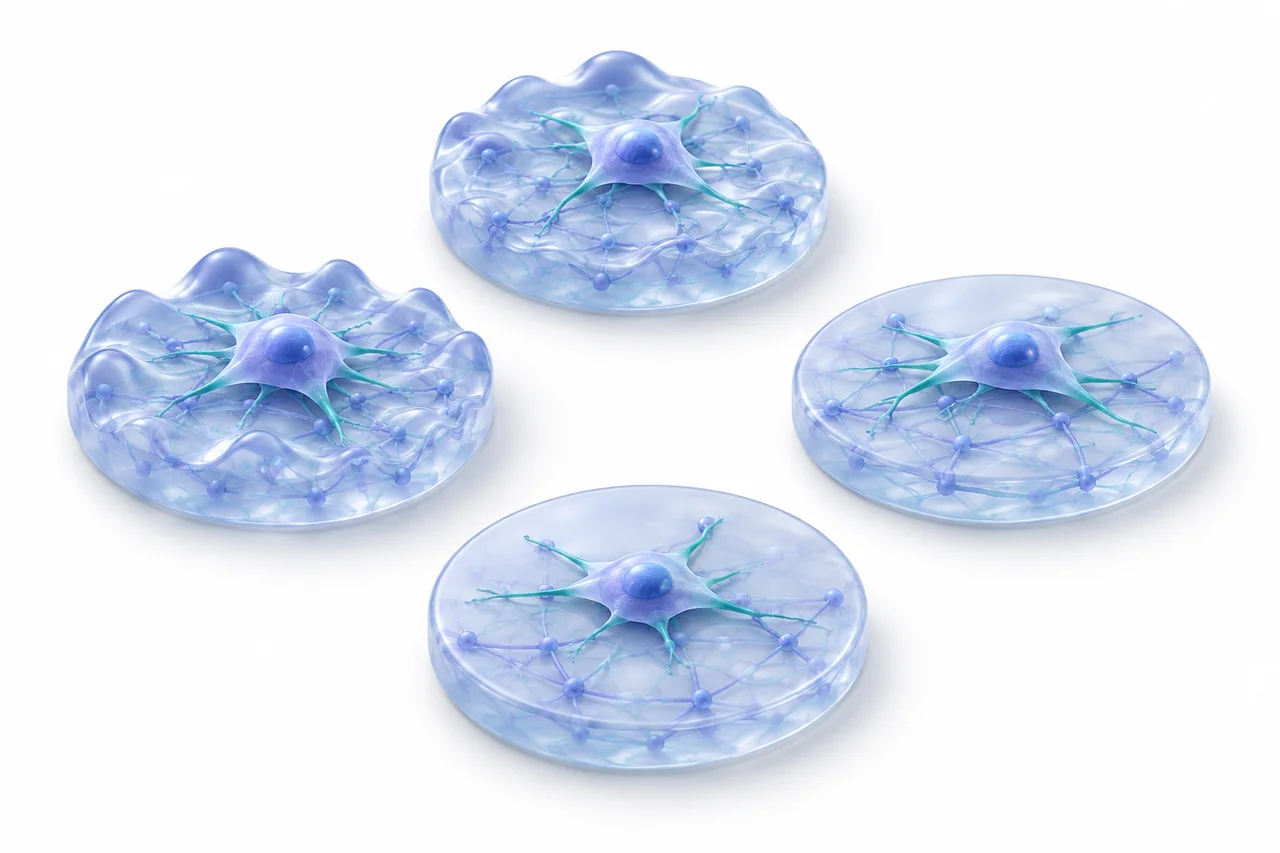
With SENCE™, choose from defined nominal stiffnesses of 0.5, 3.5, 9 and 50 kPa. The aim is to investigate substrate stiffness alongside ECM type and attachment, with the controls agreed for your experiment. For organoids or other complex models supported on the surface, an additional scaffold or matrix overlay needs its own evaluation.
Planning animal-free cell culture
Start by defining which materials your workflow must exclude. Check the origin of the culture surface, ECM coating, medium, supplements and other reagents. A synthetic hydrogel describes the material; that label alone does not establish that the complete culture workflow is animal-free.
SENCE™ supplies the hydrogel-coated surface, while you choose the ECM and biological reagents. Bring your animal-free or animal-component-free requirements to the team so that material documentation and preparation can be checked together. The scope matters: a claim about a supplied component is different from a claim about the complete assay.
Animal-free, xeno-free and serum-free: what changes?
- Animal-free / animal-component-free: check exactly which ingredients and manufacturing inputs the supplier’s claim covers. Animal-origin-free terminology also needs a stated scope.
- Xeno-free: for human-cell workflows, this excludes non-human animal components; human-derived materials may still be used.
- Serum-free: excludes serum, but other animal-derived ingredients may remain.
- Chemically defined: refers to specified chemical composition; it is not another name for animal-free or synthetic.
Supplier definitions can differ. See STEMCELL’s formulation definitions and Gibco’s cell-culture quality definitions, then use the documentation for the actual reagents in your experiment.
What does an ECM-coated surface mean?
Extracellular-matrix proteins form the coating that cells encounter. An ECM coating is different from the underlying hydrogel coating. SENCE™ supplies that underlying hydrogel with binding chemistry; it does not arrive with every possible protein coating already applied.
Specify the ECM type and how it attaches to the surface. ECM attachment or tethering describes the protein’s anchorage, whereas cell attachment describes how the cells interact with their coated substrate. Keep these separate when interpreting a change in cell fate, differentiation, expansion or function.
What should you discuss with us?
Your cell type, current plate or coverslip, coating, culture duration, imaging or assay method, and the result you need to measure. These are the starting points for a useful technical conversation.